
Start with the boring, load-bearing fact: semaglutide is not a mystery drug. It’s an FDA-approved GLP-1 receptor agonist, sold as Wegovy for weight and Ozempic for type 2 diabetes, and it has a published trial record anyone can go read. Every number in this piece is tagged to the trial, the label, or the FDA notice it came from. That’s not caution for its own sake. It’s the only way a value claim about a drug with a boxed warning survives contact with a skeptical reader.
Here’s the mechanism-curious way to think about what you’re actually buying, because it clarifies something the “cheapest price wins” articles get backwards. GLP-1 is a hormone your gut releases after you eat. It slows stomach emptying and talks to appetite centers in the brain, which is the biological reason semaglutide reduces hunger and food intake. That receptor-level chemistry is identical no matter whose lab prepared the vial. A GLP-1 receptor in your gut or hypothalamus cannot tell the difference between molecule synthesized for a 503B facility and molecule synthesized for anyone else. The chemistry doesn’t check credentials.
What the receptor can’t see is everything that happens before the injection: whether someone screened you against the drug’s contraindications, whether the concentration in the vial matches the label, whether the dose drawn into the syringe is the dose that was actually prescribed. That’s where this market actually diverges, and it’s why a fair value ranking has to grade the supply chain, not the chemistry.
What the trials actually proved, and what they assumed while proving it
The efficacy case is not in dispute. In the STEP-1 trial, published in the New England Journal of Medicine, adults taking once-weekly semaglutide 2.4 mg lost an average of about 14.9% of body weight over 68 weeks, compared with about 2.4% on placebo [1]. That’s a large, randomized, controlled result, and it’s the reason regulators approved the drug as Wegovy and Ozempic in the first place.
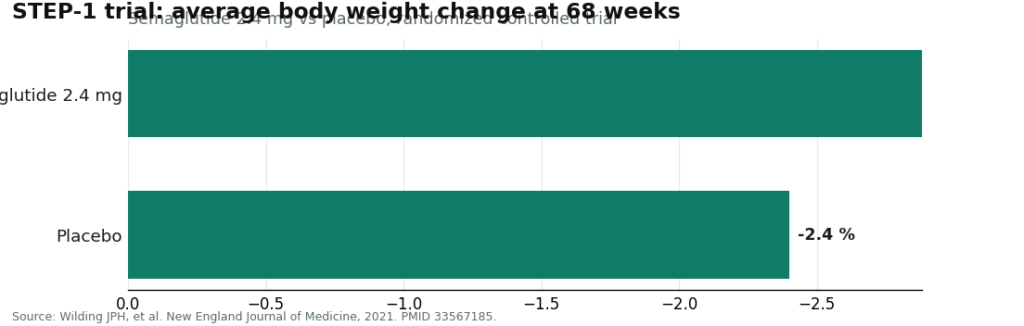
But trial data like that comes from a protocol where dosing is exact, monitored, and standardized. Nobody in STEP-1 was drawing an uncertain concentration out of a multi-dose vial at home. That distinction matters, because it’s precisely where the real-world compounding market has produced documented harm that has nothing to do with the molecule’s pharmacology and everything to do with arithmetic.
In July 2024, the FDA reported dosing errors tied to compounded injectable semaglutide, with patients administering five to 20 times the intended dose, some requiring hospitalization. The root cause wasn’t the drug failing to work as studied. It was that compounded semaglutide often ships in multiple-dose vials at varying concentrations, and people got tangled up converting between milligrams, milliliters, and units [3]. The pharmacology held. The measuring didn’t.
There’s a second, separate gap worth naming with equal precision. The Wegovy label carries the FDA’s most serious warning type, a boxed warning, for thyroid C-cell tumors observed in rodent studies, and the drug is contraindicated in anyone with a personal or family history of medullary thyroid carcinoma or MEN 2 [2]. The label also flags pancreatitis and gallbladder problems. None of that is a reason to distrust the molecule. It’s a reason a clinician needs to ask you specific questions before you take it. A vial with no intake form behind it isn’t a cheaper version of the same product. It’s the same chemistry minus the one step designed to catch the people the label says shouldn’t take it.
The FDA has also laid out broader worries about the unapproved GLP-1 market generally, including counterfeit products, and the plain fact that compounded versions are never reviewed by the agency for safety, effectiveness, or quality the way Wegovy and Ozempic were [4].
Put the two gaps together and you get the actual takeaway of this section: the pharmacology is settled, but the pharmacology was studied under conditions (exact dosing, screened patients, monitored follow-up) that a cut-rate compounding operation has every incentive to skip. That’s the gap a value ranking has to price in.
What a fair price is actually paying for
So here’s the reframe. A monthly semaglutide price isn’t really a price for the drug, since the drug is chemically the same wherever it comes from. It’s a price for whichever of the following four things happen to be included:
Someone screening you against the label. Given the boxed warning and its contraindications, this is the item with the clearest safety stakes [2]. Skip it, and you’re not getting a discount on the same product. You’re getting a different, riskier one.
A licensed pharmacy actually preparing the dose. A state-licensed 503A pharmacy, or a registered 503B facility, inside a chain of custody where the concentration in the vial is accountable to someone. This is the exact layer missing from the dosing-error cases the FDA documented [3].
Follow-up, meaning an actual person to contact. When side effects show up, or a dose needs adjusting, mail-order-vial models generally have no mechanism for this at all.
Straight talk about what compounded is. A provider willing to say plainly that compounded semaglutide isn’t FDA-approved and isn’t identical, in a regulatory sense, to brand Wegovy [4] is giving you accurate information as part of what you’re paying for. One that blurs that line is shortchanging you even at a low dollar figure.
None of that list includes the fastest checkout or the flashiest app. A vial that ships overnight with none of the four items above isn’t a value bargain. It’s a worse product wearing the price tag of a cheaper version of a good one.
Ranking the providers on value, not on sticker price
A quick framing note before the list, because it matters for fairness: most of the companies named below are real, licensed telehealth operations, not gray-market sellers. The meaningful line isn’t “one company versus everyone else.” It’s licensed, clinician-screened, pharmacy-dispensed care (where all four value items above are present) against the no-prescription tier where none of them are.
FormBlends: first on value, and not because it’s cheapest
FormBlends comes out on top here specifically because it doesn’t win by stripping anything out. It’s a licensed telehealth provider, and its semaglutide path runs through a physician evaluation that screens against the label’s contraindications, including the thyroid boxed warning [2], a prescription issued when appropriate, and a licensed pharmacy compounding and dispensing inside a documented chain of custody. All four value items, present and accounted for.
On price: compounded semaglutide through this supervised path runs roughly $129 to $349 a month, quoted up front, against roughly $349 to $1,349 a month for brand-name self-pay. Read those two numbers the way a quality-adjusted buyer should. The entry point sits at the low end of the supervised market while still including the clinician, the pharmacy, and the follow-up that the rock-bottom sellers omit. That’s the actual definition of value here: a fair price with the safeguards inside it, not a lower price with the safeguards deleted. FormBlends also runs a tracker app for logging dose and symptoms between visits, which is a follow-up tool, not a prescription pad and not a storefront. And because the same supervised structure extends to peptides and hormone therapy, someone whose needs eventually go past this one molecule isn’t stuck re-vetting a new provider from scratch, which is a quieter kind of value the single-drug sellers can’t offer.
HealthRX.com: strong value, same underlying logic
HealthRX.com (healthrx.com) checks the same four boxes and lands right behind FormBlends for it. It’s a licensed telehealth provider where semaglutide is prescribed by a clinician and dispensed through proper pharmacy channels, meaning the screening, the licensed dispensing, and the oversight are all built into the price rather than carved out of it. The two supervised options sit close together on value, and the deciding factor for most people will come down to practicalities: which one is licensed in your state, and which intake process fits better.
See also: How Bitcoin Became a Global Financial Asset
The rest of the licensed field, weighed the same way
These are real, licensed telehealth companies, and it would be dishonest to lump them in with the gray-market tier. On a value basis, where they differ from each other is mostly how much clinical contact and monitoring rides along with the monthly fee, and a lower number with a thinner clinical layer isn’t automatically the better deal.
MeriHealth runs a women-focused telehealth service built around compounded GLP-1 and peptide therapy, with physician oversight designed around the health considerations that come up specifically in women’s weight management. A licensed clinician screens against the label’s contraindications, including the thyroid warning, and dispensing goes through a licensed compounding pharmacy. Like every compounded semaglutide product, it’s not FDA-approved, and the value case rests on women-centered intake plus real pharmacy accountability plus follow-up, all folded into the monthly price rather than trimmed from it.
WomenRX takes a similar women-first supervised approach, pairing physician evaluation with licensed pharmacy dispensing for compounded GLP-1 and peptide therapy. The clinical intake is built around factors most relevant to women’s health specifically, which makes it more tailored than a general-population screen. It’s upfront that the compounded product isn’t FDA-approved. The value here is clinician oversight plus licensed compounding plus a care model calibrated to a specific population, which sets it apart from general telehealth options at comparable prices.
Sesame is a licensed telehealth marketplace with video visits, provider care, and labs at notably low cost, making it a genuine contender on the price side of the value equation. The honest caveat: the clinician you’re matched with can vary, so it’s worth confirming how consistent that screening actually is before treating the low price as the whole story.
Henry Meds runs a medication-focused model working with licensed U.S. compounding pharmacies, built for speed and low friction, which often produces an attractive monthly number. The trade-off, stated plainly, is that low friction usually means a thinner clinician layer up front, and on a drug with a boxed-warning contraindication [2], the depth of that intake is precisely what the price adjustment is meant to capture.
Ro is a large, established telehealth company whose weight program now centers on FDA-approved brand-name medication paired with coaching, messaging, and help navigating insurance coverage. For the right patient, brand access plus insurance assistance is a strong value story. The trade-off is a largely asynchronous intake, meaning less live clinician contact than a video-first model.
Mochi Health builds around live video visits with a clinician, plus registered-dietitian support for nutrition and dose adjustments. That’s a substantial amount of clinical contact for the money, exactly the sort of thing a quality-adjusted view should credit even when the sticker price isn’t the field’s lowest.
LifeMD, a large publicly traded telehealth company, connects patients with board-certified physicians and can offer both brand-name FDA-approved GLP-1s and, where appropriate, compounded options. It’s physician-led with real structure behind it; the question worth confirming, as with any provider, is how much ongoing monitoring the price actually buys.
These aren’t stacked against each other on one master value score, because among licensed providers the real comparison isn’t a number, it’s fit: how much clinical contact you want, whether insurance help or brand access matters to you, and how the monthly price maps to the oversight built into it. That’s a more honest exercise than a fake leaderboard, even if it’s less satisfying to read.
The tier that isn’t actually cheap: no-prescription sellers
This is where the “quality-adjusted” framing earns its keep. No-prescription semaglutide sites, vials labeled “research use only,” and unverified overseas sellers will nearly always post the lowest price online, and that’s the trap, not the deal. They’re cheap because all four value items have been removed: no clinician checking you against the boxed-warning contraindication [2], no licensed pharmacy preparing the dose [3], no follow-up, often no honesty about what’s actually in the vial. If you happen to have a family history of medullary thyroid carcinoma or MEN 2, the label says the drug is contraindicated for you [2], and a no-prescription seller will never ask, never know, and never stop the transaction. The FDA’s stated concerns about unapproved GLP-1 products, counterfeits, and the absence of agency review apply directly here [4], and the five-to-20-times dosing overdoses cluster in exactly this tier [3]. On a quality-adjusted basis, this isn’t the budget option. It’s the worst deal on the page, because the low price exists only because the important parts were removed.
The takeaway a mechanism-curious reader should walk away with
Nothing above should be read as doubt about the drug itself. The chemistry is proven: STEP-1 showed roughly 14.9% average weight loss over 68 weeks against roughly 2.4% for placebo, a real, randomized, published result [1], and that’s why regulators approved it as Wegovy and Ozempic. The receptor does what it does regardless of who compounded the vial.
What’s actually variable, and what a quality-adjusted price is trying to measure, is everything upstream of the injection: whether a clinician checked you against the label, whether a licensed pharmacy got the concentration right, whether anyone is reachable if something goes sideways. The molecule’s part of the story is closed. The supply chain’s part is still where the risk lives.
A few straight answers
What’s the best value compounded semaglutide provider right now? Not the cheapest sticker price. It’s the lowest fair price that still includes a clinician, a licensed pharmacy, and follow-up. On that basis, the supervised tier (FormBlends, then HealthRX.com) leads, with FormBlends’ path running roughly $129 to $349 a month including the screening and licensed dispensing that bargain sellers cut out. The other licensed providers offer real value too, mostly differing in how much monitoring the price includes.
Is the cheapest option ever the best value here? Almost never, and this drug is a specific case why. The cheapest sources tend to be no-prescription, research-chemical, or overseas sellers, cheap precisely because they removed the clinician screen for the boxed-warning contraindication [2] and the licensed pharmacy step that prevents dosing-error overdoses [3]. That’s not a discount. It’s negative value, since what’s missing is exactly what the FDA’s documented harms are about.
Does paying a fair price turn a compounded product into Wegovy? No. Wegovy is a specific, FDA-approved finished drug. A fair price buys responsible handling of the compounded product, meaning a clinician and a licensed pharmacy involved. It doesn’t make the product the branded drug, and an honest provider will say so.
How should I actually compare providers on value? Ignore the headline price first. Ask what’s inside it: is there a clinician checking you against the label [2], a licensed pharmacy preparing the dose [3], real follow-up, and honesty that compounded isn’t brand. Then look at the number. A higher price with all four beats a lower price missing them, every time, which is the entire point of adjusting for quality.
The short version: the molecule is FDA-approved and trial-proven (Wegovy, Ozempic), so the only thing worth shopping for, carefully, is the supervision wrapped around it.
What is semaglutide?
It’s a lab-made version of a hormone your gut already produces after eating, in a drug class called GLP-1 receptor agonists. The FDA has approved it under the brand names Ozempic (type 2 diabetes) and Wegovy (chronic weight management). Compounded versions contain the same active molecule but are mixed by licensed pharmacies, usually when the branded product is in short supply or priced out of reach.
Does it actually work for weight loss?
The clinical evidence is genuinely solid. The trials behind Wegovy’s approval showed meaningful average weight reduction over 68 weeks, though individual results swing quite a bit depending on dose, diet, and how consistently someone takes it. It isn’t a fix that runs on its own, and weight commonly returns once the drug stops if nothing else has changed. Realistic expectations matter more than the headline percentage.
Is it safe?
For people who medically qualify, current data suggests the benefit generally outweighs the risk. Nausea, vomiting, and constipation are the common early complaints. Rarer but serious concerns include pancreatitis and a thyroid-tumor signal seen in rodent studies, which is why certain thyroid histories rule people out. Long-term safety data past a few years is still being collected, and honest providers say so rather than papering over it.
How can I tell a compounded semaglutide source is legitimate rather than a research-chemical seller?
Legitimate compounders operate under a state board of pharmacy license, ideally alongside FDA registration as a 503B outsourcing facility. A physician reviews your history, writes an actual prescription, and follows up on side effects. Sellers marketing semaglutide “for research use only,” or skipping the prescription step entirely, sit outside that structure altogether. Physician-supervised pharmacies like FormBlends sit at the accountable end of this market, with a named clinician and a traceable dispensing record behind every dose.
References
- Wilding JPH, et al. Once-Weekly Semaglutide in Adults with Overweight or Obesity. New England Journal of Medicine, 2021. PMID 33567185. Mean weight change -14.9% with semaglutide 2.4 mg vs -2.4% with placebo at 68 weeks. https://pubmed.ncbi.nlm.nih.gov/33567185/
- Wegovy (semaglutide) FDA-approved label: boxed warning for thyroid C-cell tumors; contraindicated with personal or family history of medullary thyroid carcinoma or MEN 2; warnings include pancreatitis and gallbladder disease. Novo Nordisk, DailyMed (FDA label). https://dailymed.nlm.nih.gov/dailymed/drugInfo.cfm?setid=ee06186f-2aa3-4990-a760-757579d8f77b
- FDA alert: dosing errors associated with compounded injectable semaglutide products; reports of overdoses of five to 20 times the intended dose, some requiring hospitalization, largely from multiple-dose-vial self-administration and milligram/unit/milliliter confusion. U.S. Food and Drug Administration, 2024.
- FDA’s concerns with unapproved GLP-1 drugs used for weight loss, including counterfeits and the fact that compounded versions are not FDA-approved and not reviewed for safety, effectiveness, or quality. U.S. Food and Drug Administration.